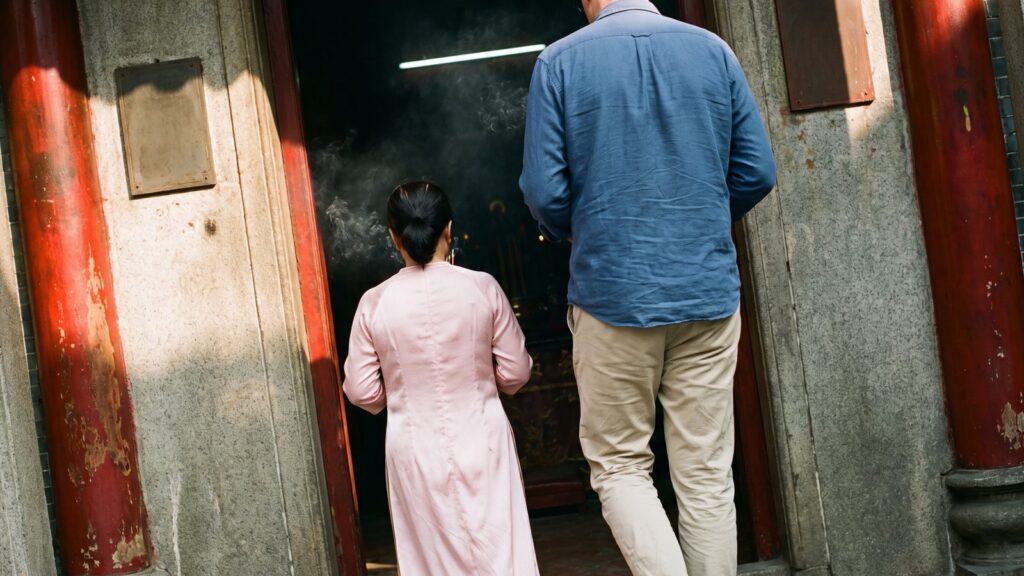
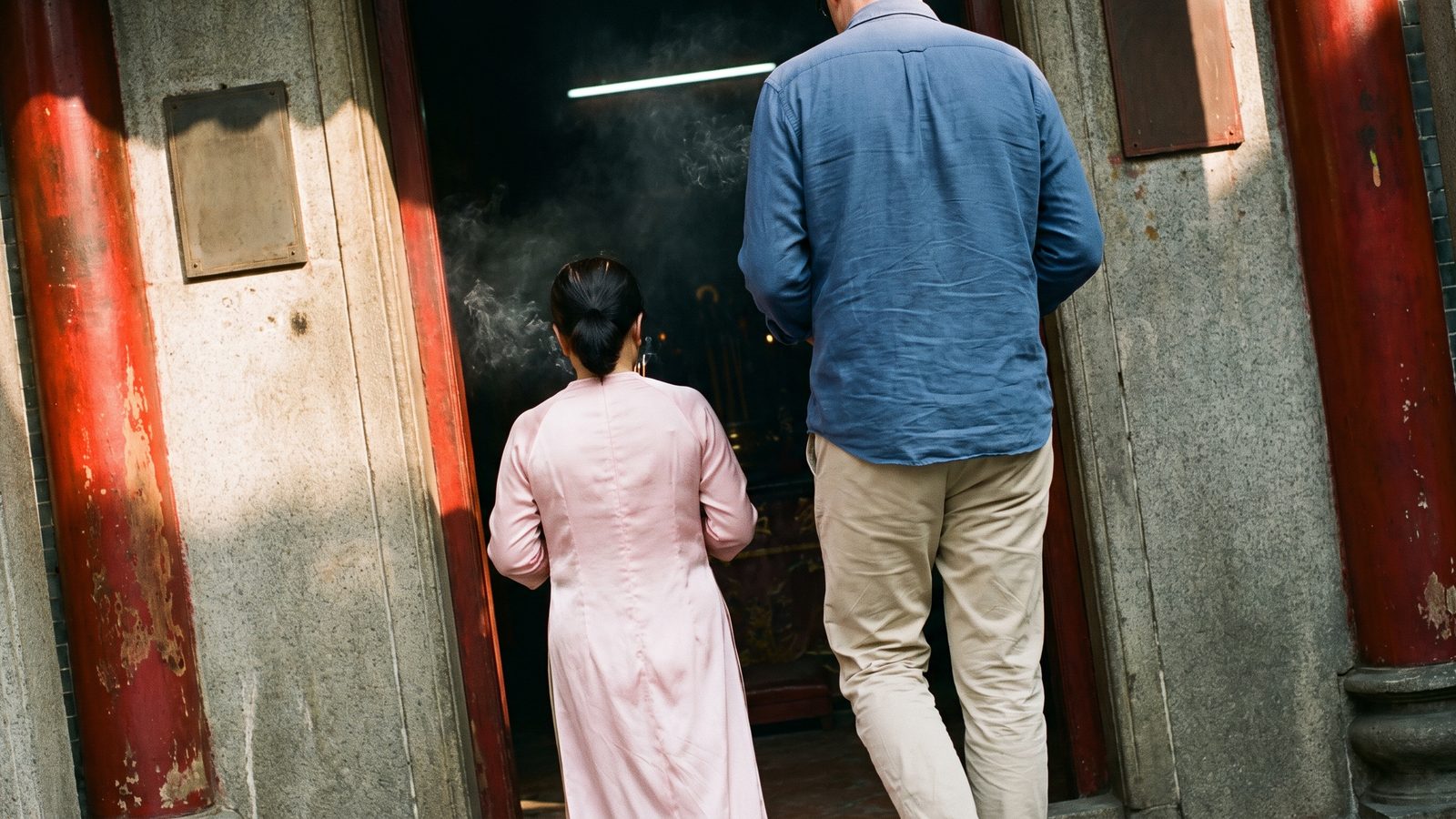
Thien Hau Temple: the incense temple of Cholon
Thien Hau Temple is the one stop in Cholon that almost every visitor keeps. It was built by the Cantonese community around 1760, it costs nothing to enter, and it is still a working place of worship. This is what the building is, when it opens, and how to read what you are looking at.
- Built around 1760 by Cholon’s Cantonese community. Its official name is the Tuệ Thành Assembly Hall.
- Free entry. It is a temple, not a museum, and donations are the only money involved.
- Open about 6:00 to 11:30 and 13:00 to 16:30. Some listings give 6:00 to 17:30 without a break.
- The incense coils burn for days. Each one carries a paper tag with a name and a wish.
- Allow 30 minutes inside, and about 2 hours for Cholon around it.

What Thien Hau Temple is
Thien Hau Temple stands at 710 Nguyễn Trãi, in the Chợ Lớn ward of Ho Chi Minh City.
Its official name is the Tuệ Thành Assembly Hall, the meeting house of the Cantonese community that raised it. In Cantonese it is Po Miu, in Vietnamese Chùa Bà Thiên Hậu.
The temple honours Mazu, the Chinese goddess of the sea. She was born Lin Moniang in Fujian in 1044. The Song court gave her the title Thiên Hậu Thánh Mẫu in 1110.
The Cantonese who crossed to Saigon brought her with them. Their hall, built around 1760, is the oldest of the Cholon temples still in daily use.
The building was repaired or enlarged in 1800, 1842, 1882, 1890 and 1916. Vietnam listed it as a national architectural and artistic relic in 1993.
It is one stop inside a larger neighbourhood. The halls, the market and the medicine streets around it are covered in our Cholon guide.
Opening hours and entrance fee
The temple publishes no hours of its own, so every listing online is a second-hand record. We checked four in October 2026 and they split into two groups.
| What | Detail |
|---|---|
| Most listings give | 6:00 to 11:30, then 13:00 to 16:30, daily |
| Other listings give | 6:00 to 17:30 without a break |
| Entrance | Free. Donations welcome, in small notes |
| Quietest hour | 6:00 to 8:00, when locals come to pray |
| Time inside | About 30 minutes |
What you are looking at inside
The ground plan is the classic Chinese Quốc (國) layout: three halls on a single axis, front, middle and rear, joined by open courtyards. Light and smoke come down through the middle, so the building reads as a sequence rather than a single room.
The front hall
Two side altars, a painting of the goddess appearing over water, and a stone stele carrying her legend.
The middle hall
Incense burners cast in the 12th year of the Quảng Tự reign, called the largest set in the city. And the red and gold palanquin.
The rear sanctuary
Three statues of the goddess, bronze-faced, in coloured robes. The middle one stays on the altar, the largest appears at her birthday, and the third travels.
Look up. The ridge of the roof carries ceramic figures. They include a mounted duel of the general Guan Yu and the three Taoist sages of longevity, fecundity and prosperity.
Our sources disagree on who fired them. One gives the Cây Mai kiln in 1908, another the Bửu Nguyên and Đông Hòa kilns. Both attributions are in circulation, so we give you both.
The temple keeps about 400 old pieces: stone statues, steles, lacquered panels, parallel paintings and 23 parallel sentences. A bronze bell dated 1830 hangs here, rung when a large donation is made.
The rituals, and the two dates that matter
Thien Hau Temple is busy every day, but two dates in the lunar calendar fill it. Both are worth planning around, in one direction or the other.
- 13rd lunar month, 23rd day
The birthday of the goddess
Her statue leaves the altar and is carried on the palanquin through the streets of Cholon. Lion, unicorn and dragon dancers and folk musicians go with it.
- 27th lunar month, 7th day
Qixi, the night for love
Young visitors come to pray over relationships. The temple prepares offering sets at 40,000 to 80,000 VND (about $1.50 to $3).
- 31st lunar month
Lunar New Year
The busiest stretch of the year. Hours are sometimes extended, and the halls are full from opening.
On an ordinary morning you see what the temple is really for. Shopkeepers from the surrounding streets come to “open the year” or “open the shop”. Regulars buy incense, write their wishes and hang them. Nobody performs for visitors, and the quietest hour is 6:00 to 8:00.
Getting there from District 1
The temple sits about 7.5 km south-west of the city centre, and about 9 km south of Tân Sơn Nhất airport. No metro station is near it. Line 1 ends at Bến Thành Market, some 8 km away, so the last leg is a road ride.
| From | Ride | Time |
|---|---|---|
| District 1, taxi or ride-hailing car | metered or app price | 10 to 15 minutes |
| District 1, motorbike or Grab bike | about 50,000 VND (about $1.90) | 12 to 18 minutes |
| Tân Sơn Nhất airport | metered or app price | 25 to 40 minutes |
Six bus routes stop near the temple: 05, 08, 54, 56, 62 and 150. Ask the driver for Nguyễn Trãi, and you will be dropped within a short walk.
Once you are in Cholon, walk. The market, the assembly halls and the medicine street all sit inside a twenty-minute radius, and the traffic moves slower than you do.
What to see next in Cholon
Almost nobody visits the temple alone. Everything worth seeing in Cholon is within walking distance.
Nghĩa An Assembly Hall
676 Nguyễn Trãi, two minutes along the same street. Dedicated to Guan Yu, and the busiest hall for worshippers asking about business.
Bình Tây Market
57A Thạp Mười, opened in 1930. The wholesale trade runs 6:00 to 9:00 and is worth seeing.
Cha Tam Church
25 Học Lạc. A yellow-walled Catholic church, with a plaque on the pew where Ngô Đình Diệm was seized on 2 November 1963.
Two more streets are worth the detour. Lương Nhữ Học is the lantern street, covered in colour before the Mid-Autumn Festival. Hải Thượng Lãn Ông is the traditional medicine street, where the apothecaries still weigh and mix herbs in front of you.
Two hours covers the quarter at an easy pace, half an hour of it inside the temple. Our Cholon guide puts the stops in order, and the city tour comes through here by motorbike.
How to behave in a working temple
This is not a heritage site with a ticket desk. People pray here every morning, and the rules of the house are the usual ones.
- Dress plainly. Skip the tank top, the short shorts and the short skirt.
- Ask before photographing a ceremony, and keep the camera off people praying at close range.
- Do not touch the statues, the steles or the ceremonial objects.
- Keep your voice low in the rear sanctuary, where the goddess herself is.
- Take your rubbish with you and leave the courtyard as you found it.
Questions we get on the bike
Is Thien Hau Temple free to enter?
Yes. There is no ticket at any hour. Donations are welcome in the box by the main altar.
What are the opening hours of Thien Hau Temple?
Most listings give 6:00 to 11:30 and 13:00 to 16:30, daily. Others give 6:00 to 17:30 without a break. The temple publishes no hours itself, so plan around the morning window.
How do I get to Thien Hau Temple from District 1?
It is about 7.5 km south-west of the centre. A taxi or ride-hailing car takes 10 to 15 minutes, a Grab bike 12 to 18 minutes and about 50,000 VND. Buses 05, 08, 54, 56, 62 and 150 stop nearby.
How long should I spend at Thien Hau Temple?
About 30 minutes inside. Allow 2 hours to walk Cholon properly, since the market and the other assembly halls are close by.
When is the Thien Hau Temple festival?
The birthday of the goddess falls on the 23rd day of the third lunar month. Her statue is carried through the streets of Cholon on a palanquin, with lion, unicorn and dragon dances.
Why are there incense coils hanging in the temple?
Each spiral is a prayer left to burn. A visitor writes a name and a wish on a paper tag. The staff hang the coil under the skylight, and it burns for several days.
What should I wear to Thien Hau Temple?
Simple and respectful clothing. Avoid tank tops, short shorts and short skirts. There is no dress code on the gate, and the expectation comes from the people praying there.

Clara grew up just outside Saigon and moved to the city five years ago to study. She has been riding its streets ever since.
Most evenings you’ll find her leading our night rides, usually with a bowl of snails waiting at the end. Everything in this guide is what she tells her own guests before the first stop.
See Cholon from the back seat
The City Tour reaches Thien Hau Temple around 11:50 and gives you time inside, then carries on to Bình Tây Market. Four hours, 8:30 AM or 1:30 PM, with a local woman guide at the handlebars.