Is Street Food Safe in Vietnam? An Honest Answer From Saigon
What actually makes travellers sick, how to choose a stall, and what to do if your stomach turns. No promises, no scare stories.
No street food is risk-free, in Vietnam or anywhere else. The risks are known: untreated water and ice, raw meat or seafood, and cooked food left sitting out. Pick busy stalls that cook to order, drink sealed bottled water, and accept only tube ice.

The short answer
Yes, you can eat street food in Vietnam and stay well. No, nobody can promise that you will. Both are true, and anyone who tells you only one of them is selling something.
This page is about Saigon, where I live and eat. The facts come from our own fact sheets, last checked in September 2026. Where a fact is missing, I say so instead of filling the gap.
The good news is that the risks are not random. They cluster around a few habits you can spot from the pavement. Learn them once, and you can eat where the locals eat.

My rule on street food fits in one line. Ice from a factory bag, water from a sealed bottle, and nothing that has not been cooked through in front of you.
What actually makes travellers sick
The health advice I work from names a short list of food risks. Three habits cover it, and each one is easy to see.
- Untreated water, and ice made from it. Tap water in Saigon is not safe to drink. Ice frozen from that water carries the same problem, and it melts straight into your glass.
- Raw meat and raw seafood. The advice is to avoid them. That includes tiet canh, a raw blood dish. If you cannot tell whether something is cooked, ask or skip it.
- Pre-cooked food that sits out. A tray of cooked food, uncovered and waiting for customers, is the stall to walk past. Time and warmth are the problem, not the cuisine.
Notice what is not on the list. Chilli, fish sauce, small plastic stools and a pavement kitchen are not risks in themselves. A stall can look rough and still cook safely.
One drink belongs here, even though it is not food. The UK government reports deaths from methanol poisoning linked to street liquor. Our safety notes also flag unbranded spirit cocktails around Pham Ngu Lao. Skip them.
How to pick a stall
You choose a stall with your eyes, before you sit down. Four signals do the work, and you can check all of them in the time it takes to walk past.
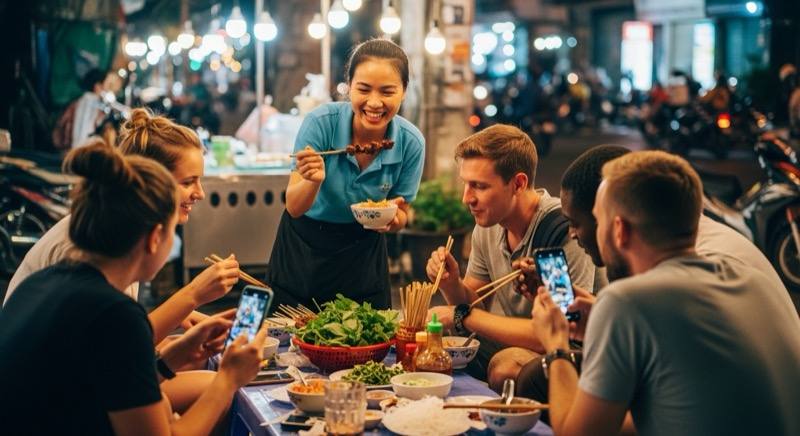
Turnover. A stall with a queue and full stools moves its food fast. Ingredients do not sit for long when bowls keep leaving the counter.
Cooked to order, and hot. You want to see your food hit the pan, the grill or the boiling pot after you order. Steam rising from the bowl is a good sign. Lukewarm is not.
Covered ingredients. Raw ingredients and toppings should sit under a lid, a cloth or a glass case. Open trays with flies landing on them tell you the rest.
Money and food handled separately. Watch who takes the cash. Ideally, the hand that touches the notes is not the hand that touches your noodles.
The warning sign matters as much as the good ones. Skip any stall where cooked food has been sitting out, however good it smells. A pleasant smell tells you about the recipe, not about the hours on the tray.
Timing helps too. This part is my own reasoning rather than a rule from the fact sheet: eat when the locals eat, because busy hours mean fresh batches.
On Ho Thi Ky in former District 10, the peak runs from 19:00 to 22:00. On Vinh Khanh in former District 4, the street gets busy from 17:00. Our night markets guide covers more evening spots.
Tube ice or chipped ice
Ice is the question every visitor asks, and the answer depends on which ice. Saigon runs on two kinds. They come from different places and do different jobs.
Tube ice, called da vien, is made in a factory and arrives in sealed bags. The pieces are short cylinders with a hole through the middle. Our fact sheet treats this ice as safe for drinks.
Chipped block ice, called da cay, starts as a large block that someone breaks up by hand. It is meant for chilling beer and seafood, not for your glass. Avoid it in drinks.
If you cannot tell which ice you have, order your drink without it. Say khong da, which means no ice.
Iced milk coffee, ca phe sua da, costs 15,000 to 25,000 VND on the street. It is worth learning the ice rule for that drink alone.
Can you drink the tap water?
No. Tap water in Saigon is not safe to drink, and ice made from it carries the same risk. That is the plain answer, and there is no clever exception to it.
Drink sealed bottled water. Check that the cap has not been opened before you pay for it.
The question gets harder at the stall. A soup served boiling hot is not the worry. Cold drinks, raw garnishes and anything rinsed and served without cooking are where the tap water rule follows you onto the street.
What the 2026 inspections change
Saigon has around 14,300 street vendors. According to the Saigon newspaper SGGP, the city’s 2026 plan has two tools. One is surprise inspections. The other is a public blacklist of vendors who break the rules.
Here is what that changes for you. It adds pressure on vendors to keep ingredients covered and cooking clean. It gives the city a way to name repeat offenders. Neither of those makes any single stall safe.
Here is what I could not verify. I do not know how many stalls have been inspected, or how often. I do not know what a failed inspection costs a vendor.
I also do not know where the blacklist is published, or whether a visitor can read it in English. Until those details exist, I cannot tell you to check it before dinner.
So treat the plan as a reason for mild optimism, not as a certificate. The four signals above work tonight, at any stall, with or without an inspector.
Cut fruit and fresh juice
My fact sheets hold no verified data on cut fruit. This section is reasoning from the rules above, not research.
Fruit cut ahead of time and left uncovered behaves like any other food that sits out. It warms up, it collects dust, and nobody can tell you when it was cut. Apply the same rule and skip it.
Fruit cut in front of you, from a whole piece, is a different case. So is fruit you peel yourself. The knife and the board still matter, and so does the water that rinsed them.
Juices and shakes bring the ice question back. Nuoc mia, fresh sugarcane juice, costs 10,000 to 20,000 VND. If it comes over ice, check which ice. If you cannot tell, ask for it without.
If your stomach turns
Careful eaters still get an upset stomach on a trip now and then. That is not a failure of the rules, and it is not a reason to panic. It is a reason to get proper advice.
I am a guide, not a doctor, so I will not tell you what to take. A pharmacy can advise on mild symptoms. See a doctor if symptoms are strong, if they last, or if they worry you.
Not every fever on a trip comes from food. Dengue is endemic in Vietnam and peaks in the rainy season. Saigon recorded 31,032 cases in 2026 up to 6 September.
The city expects the dengue peak in November and December. A fever is a reason to see a doctor, not a reason to guess.
In an emergency, call 115 for an ambulance. The police number is 113. English is not guaranteed on these lines, so ask a hotel receptionist or a Vietnamese speaker to help you call.
Our safety notes list three places with English-friendly care for visitors:
- FV Hospital, 6 Nguyen Luong Bang, former District 7. JCI accredited. Emergency line (028) 35 11 35 00.
- Family Medical Practice, Diamond Plaza, 34 Le Duan, former District 1. Open 24/7 on +84 28 3822 7848, emergency *9999.
- Vinmec Central Park, 208 Nguyen Huu Canh, Binh Thanh. Phone +84 28 3622 1166.
Before you fly, check that your travel insurance covers evacuation by air ambulance. The UK government says it must, and it costs nothing to read your policy.
Our health notes also list typhoid and hepatitis A vaccines for Vietnam. Whether you need them is a question for your doctor or a travel clinic, asked before you leave.
A note for vegetarians
Eating vegetarian removes one item from the risk list: raw meat and raw seafood. It does not touch the others. Water, ice, cut produce and food left sitting out work the same way at a vegetarian stall.
My fact sheets hold no hygiene data specific to vegetarian stalls. So I will not claim they are cleaner, and I will not claim they are riskier. Use the same four signals.
If you would like someone to find the stalls for you, our Vegan Food Tour is built around plant-based dishes.
Questions people ask
Is street food riskier than a restaurant in Vietnam?
Not automatically, in either direction. The risks are water, raw food and food left sitting out. A restaurant can get those wrong as easily as a stall. Judge the kitchen you can see.
Can I have ice in my drinks in Saigon?
Tube ice, the cylinders with a hole in the middle, comes from factory bags and is the kind to accept. Avoid jagged chipped ice, which is meant for chilling beer and seafood. When in doubt, order without ice.
What should I do if I get sick after eating?
Ask a pharmacy about mild symptoms and see a doctor for anything stronger or lasting. In an emergency, dial 115 for an ambulance. FV Hospital’s emergency line is (028) 35 11 35 00.
Do the 2026 inspections make every stall safe?
No. The plan adds surprise inspections and a public blacklist, which puts pressure on vendors. I could not find how many stalls are checked or where the list is published. Keep using your own eyes.
For the dishes themselves, and the streets that sell them, read our Saigon street food guide. A hot bowl cooked to order passes most tests on this page. Our guide to the best pho in Saigon lists where to find one.
Worried about more than food? Our page Is Ho Chi Minh City Safe? covers traffic, scams and theft.
If you would rather let a local choose every stall, our Saigon Street Food Tour does exactly that.
Clara grew up just outside Saigon and moved to the city five years ago to study. She has been riding its streets ever since. Most evenings you’ll find her leading our night rides, usually with a bowl of snails waiting at the end. Everything in this guide is what she tells her own guests before the first stop.